How to Tell If Your Garage Floor Needs Recoating (Orlando Edition)
Locally based epoxy floor specialists serving the Orlando metro.
- Licensed & Insured in Florida
- Locally Owned, Orlando-Based
- 15-Year Polyaspartic Topcoat Warranty
- Free On-Site Estimates
- 0% Financing Available
An epoxy or polyaspartic garage floor isn’t permanent. With a properly prepped install in the Orlando climate, you can expect 15-20 years of service before recoat consideration. But the floor will give you warning signs before it gets to the point of needing a full strip-and-redo. Catching those warning signs early lets you do a recoat instead of a full rebuild — saving thousands of dollars and weeks of garage downtime. Here’s what to look for on an Orlando-area garage floor and what each sign means.
1. Loss of Gloss
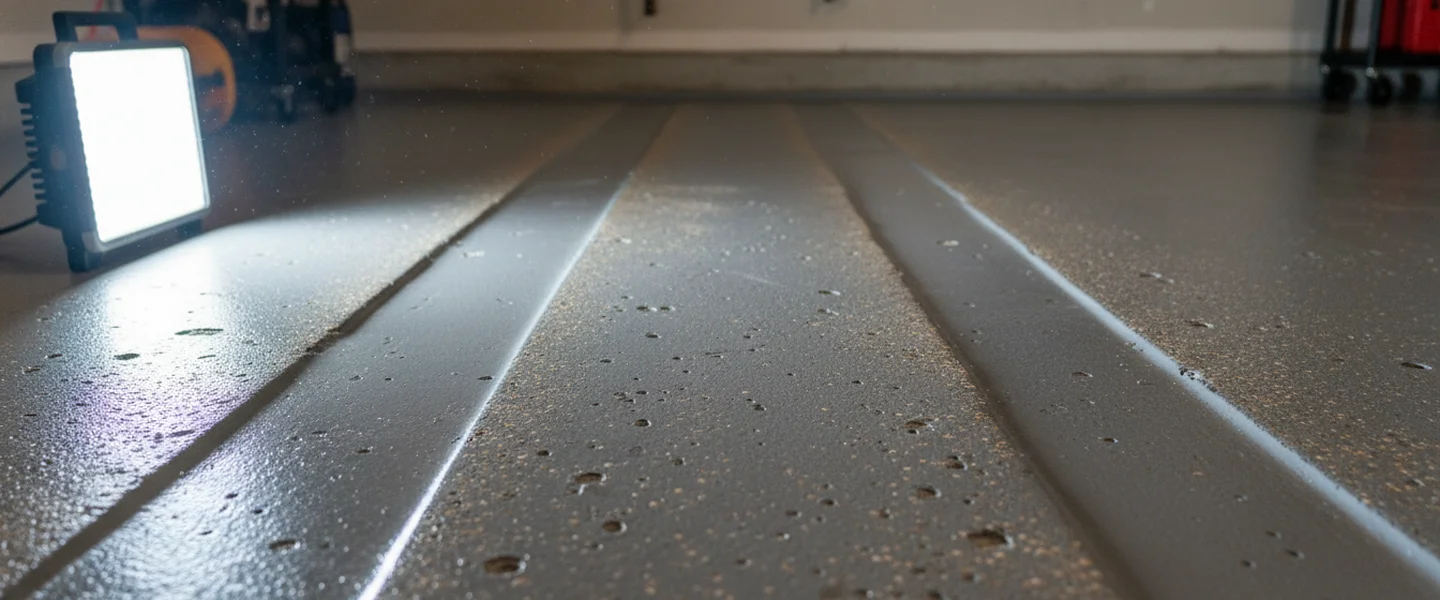
The most common early warning. A floor that used to shine wet-look when fresh now looks matte and dull, especially in the tire-track zones where most of the wear happens. The cause is normal abrasion of the topcoat layer over years of use, accelerated by UV exposure in our climate. The fix is a topcoat refresh — diamond-screen the surface lightly, then roll a fresh coat of clear polyaspartic over the existing system. Total downtime: a day or two. Cost: a fraction of a full rebuild.
2. Pinhole Wear in Tire-Track Zones
When you look closely at the tire tracks, you can see tiny pinholes where the topcoat has worn through to the basecoat or to the flake layer. The flake is still bonded; the topcoat has just thinned. The fix is the same topcoat refresh — scuff and recoat. If you wait until the flake itself is wearing through, the scope grows.
3. Yellowing in Direct-Sun Zones
If your garage has a south-facing door that’s often open, or a skylight, or any direct UV exposure, the topcoat can develop a slight haze or amber tint over years — in Central Florida this happens faster than anywhere else in the country. On a UV-stable polyaspartic this is rare and minor; on an older epoxy-only system this can be pronounced. The fix is the topcoat refresh — fresh polyaspartic restores clarity and locks the system back to its original look.
4. Visible Edge Curl at Cracks or Joints
When you look at the control joints or any cracks that were filled, you can see the coating starting to curl up slightly at the edge of the joint. This means moisture or movement is starting to work the bond at that detail. The fix depends on cause: if it’s slab movement (thermal cracks expanding), the joint needs to be reopened, refilled with the right flexible material, and the coating spot-repaired and refreshed. If it’s moisture, a more thorough moisture investigation is warranted before recoat.
5. Active Chipping or Flaking
If you can lift coating off the slab with a fingernail in any area, the bond is failing in that area. The fix is more significant than a topcoat refresh — the failed area needs to be cut out, the slab prepped, and a patch-and-blend repair done. If the failure is widespread (not just one spot), the system is approaching end-of-life and a full strip-and-redo is the honest answer.
6. Hot-Tire Lift Patches
If you see tire-shaped patches where the coating has lifted, your existing system was either improperly prepped originally or used a non-thermal-rated topcoat. Hot-tire lift is generally not a recoat-friendly failure — the underlying chemistry isn’t going to be rescued by adding more topcoat over it. The fix is strip-and-redo with a properly prepped polyaspartic system that handles thermal cycling at Florida summer temperatures.
7. Moisture Blistering
If you see bubbles or blisters under the coating, especially near lake-adjacent properties or in slab-on-grade garages, moisture vapor emission from the slab is pushing the coating off. This is not a recoat candidate — the system needs to come off, the moisture issue addressed with a vapor-block primer rated for the measured emission, and a new system installed. If the original installer skipped moisture testing, this is the failure mode.
How Orlando Climate Accelerates Some of These
The Central Florida climate adds a specific kind of wear that homeowners in cooler or drier climates don’t see as much. UV exposure 230+ days a year accelerates topcoat yellowing on any system without true UV-stable chemistry. Summer thermal cycling (slab heats to 110°F+ in the afternoon, cools to 75°F overnight) cycles every joint and crack in the slab daily. Year-round moisture vapor emission tests any vapor-block primer that wasn’t rated to the actual measured rate. Hot tires from I-4, the 408, and the Florida Turnpike are at 160°F+ in July and August. All of these accelerate the timeline to recoat decisions vs. drier climates.
The Recoat vs. Redo Decision
If three or fewer of the seven signs above are present, and they’re all in the “topcoat refresh” category (gloss loss, pinholes, light yellowing, minor edge curl), a recoat is the right answer. Downtime: a day or two. Cost: a fraction of a full system.
If active chipping or flaking, hot-tire lift, or moisture blistering are present, a strip-and-redo is the honest answer. The system is at end-of-life or had a fundamental install flaw, and adding fresh material on top will not extend the life.
If you’re not sure which camp you’re in, that’s exactly what the free 30-minute inspection is for. We can look at the floor, tell you whether a recoat will hold or whether a redo is warranted, and write a quote either way.
What Not to Do
Don’t power-wash a deteriorated coating and assume that “cleaning” will fix the visual symptoms. Power-washing accelerates the failure of any compromised coating and can drive water under loose areas — especially bad in our humid climate.
Don’t apply a big-box-store water-based “epoxy refresh” kit over a professional system. The chemistry rarely matches and the resulting layer fails fast under Florida UV — and now you have a hybrid mess that’s harder to strip if you eventually want a proper recoat.
Don’t ignore the moisture issue if you see blistering. Recoating over an active moisture problem is the second-most-common mistake we see on Orlando second-opinion visits (the first is acid-etch-only prep).
Orlando-Specific Recoat Considerations
The Orlando climate doesn’t restrict the install season the way Northern markets do — we install year-round, including January and February when slab temperatures are most predictable. Summer installs (July-August) work but require shorter material batches and a larger crew to compensate for shorter working windows. Hurricane season can push schedules by a day or two if a storm threatens, but doesn’t fundamentally constrain the work.
Common Misconceptions About Recoating
“You can just paint over a deteriorated coating.”
Not really. Whatever’s failing in the existing coating will still be failing after the new layer goes on. The recoat works only when the underlying system is fundamentally intact and just needs surface refresh.
“All recoats look like new construction.”
A successful recoat will look excellent — restored gloss, refreshed clarity, sealed flake. But if the underlying floor has impact damage, deep stains, or texture variation, those won’t disappear under a new topcoat. The recoat refreshes the floor, it doesn’t rebuild it.
“Recoats are short-lived; you might as well do a full redo.”
Not true when the recoat is appropriate. A properly executed topcoat refresh on a fundamentally sound system adds 5-10 years of service life at a fraction of the cost of a redo.
Bottom Line
Catch the warning signs early. Loss of gloss and pinhole wear are good news — they mean the system is still fundamentally sound and a topcoat refresh will extend the life dramatically. Chipping, hot-tire lift, and moisture blistering are bad news — they mean the system needs a redo, not a recoat. The 30-minute inspection tells us which camp you’re in. Call (689) 210-3343 for a free inspection and a written, honest recommendation.
Service Areas We Cover
We serve Orlando and the entire Central Florida metro — from Lake County to Seminole County and out to East Orange. Click your suburb for local details and the conditions we typically find in your housing stock:
Free Epoxy Floor Estimate in Orlando
Same-week appointments. No high-pressure sales. Serving Orlando and surrounding areas including Winter Park, Maitland, Altamonte Springs, Apopka, Lake Mary, Oviedo, Casselberry, Dr. Phillips.